

Magnetic records of the Moon’s formation
Different proposed Moon-forming impact events have different implications for how the Moon’s orbit evolved early in its history. In some cases, bringing the Moon to its current orbit requires a large, transient tidal heating event. I am interested in assessing the impact of such an event on generation of the lunar dynamo and determining what magnetic records of the Moon’s early orbital evolution might be present in ancient lunar materials.
I am also interested in turning this question to the outer Solar System, where transient and persistent tidal interactions are common.
Mars’s early dynamo
Mars had a core dynamo early in its history, but when that dynamo shut down is an area of active debate. On one hand, many Martian impact basins formed between 4.1-3.7 Ga look completely non-magnetic at spacecraft altitudes. Because each basin-forming event heats a massive volume of material, which then acquires magnetization in the ambient field as it cools, the simplest interpretation of these weakly magnetic basins is that Mars’s dynamo was inactive by ~4.1 Ga. However, young magnetized volcanic features suggest the dynamo was active as late as 3.6 Ga. This potential 500 Myr difference in the dynamo’s longevity could have major implications for Mars’s climate history and the properties of its deep interior!
My PhD focused on taking a multidisciplinary approach to better resolve the dynamo’s cessation age. I use a combination of paleomagnetic work and modeling to both place new constraints on Mars’s magnetic history and resolve apparent contradictions in different age constraints.
Martian meteorite paleomagnetism
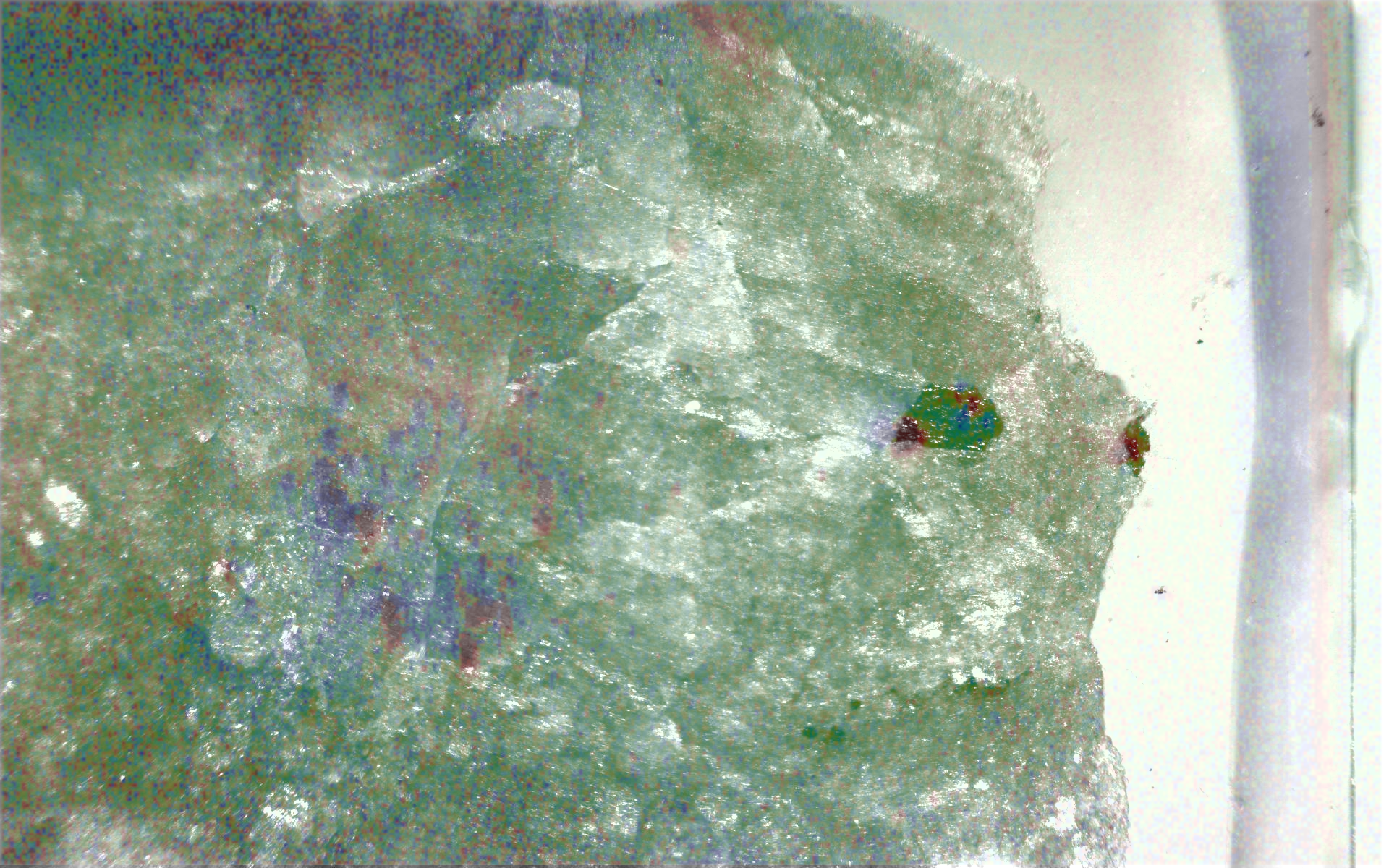
A magnetic map of part of a thick section of ALH 84001, produced with the quantum diamond microscope at the Harvard Paleomagnetics Lab, overlaid on a reflected light image of the same region.
In the absence of returned samples from Mars, Martian meteorites represent the only direct source of information about Mars’s magnetic field. Although most meteorites are either too young or too shocked to retain a magnetic record of the dynamo, the meteorite ALH 84001 is both old enough (4.1 billion years!) and relatively lightly shocked.
Taking advantage of new high-resolution magnetic imaging techniques, we characterized the paleomagnetic record of ancient minerals within an ALH 84001 sample. We found two distinct grain populations magnetized in near-opposite directions, likely reflecting magnetization acquired in two different impact events. Using the ages of impact events recorded in ALH 84001, we could date one of these magnetizations to ~3.9 Ga. This requires the Martian dynamo to have been active after 4.1 Ga, and may represent the first paleomagnetic evidence of dynamo reversals on another planet!
Read the paper here!
Large impact basin magnetism
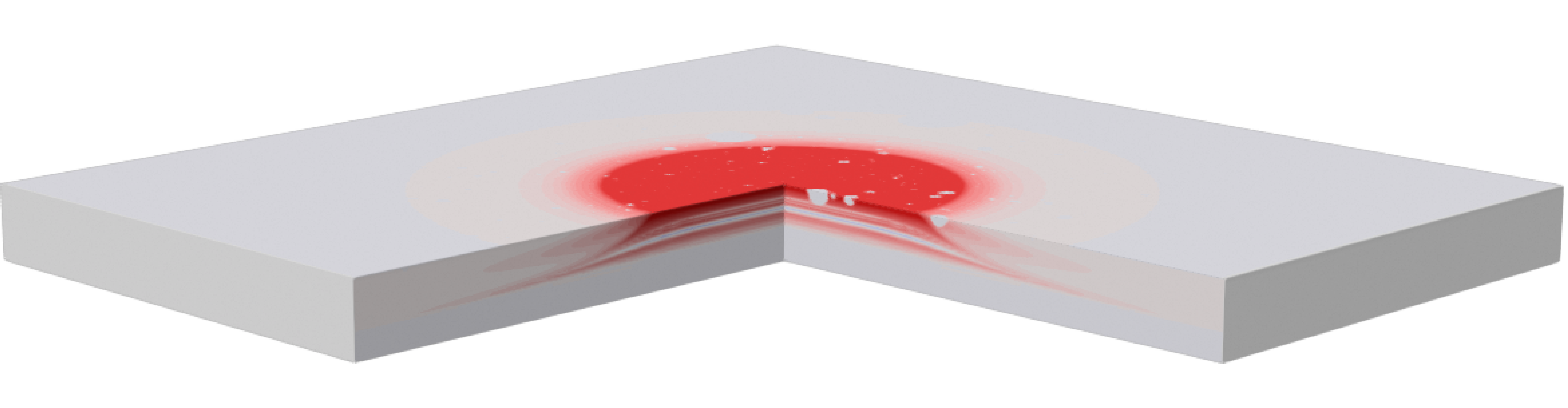
Simulated net magnetization intensity for a model martian impact basin cooled in a reversing dynamo field.
The main roadblock to a longer-lived Martian dynamo is the observation of tens of impact basins, most formed between 4.1-3.7 Ga, which appear demagnetized in satellite magnetic field measurements. However, if the Martian dynamo was reversing while these basins cooled, they may appear demagnetized even if the dynamo was active throughout their formation.
To test this hypothesis, I modeled the cooling and magnetization acquisition of Martian impact basins. I found that Earth-like or faster reversal rates could likely produce large basins that appear demagnetized today, especially if excavation and late remagnetization processes were efficient.
The intensity of magnetization acquired in a given field depends on the concentration of magnetic minerals within Martian basins. To better constrain this quantity, I used petrological modeling tools to simulate crystallization of mantle-derived impact basin melts on Mars. I found that the concentration of magnetic minerals would likely be lower than in the surrounding crust, but not low enough for impact basins to appear as weakly magnetic as observed if the dynamo was active and non-reversing throughout their cooling histories.
Read the papers here and here!
Mercury analogue materials
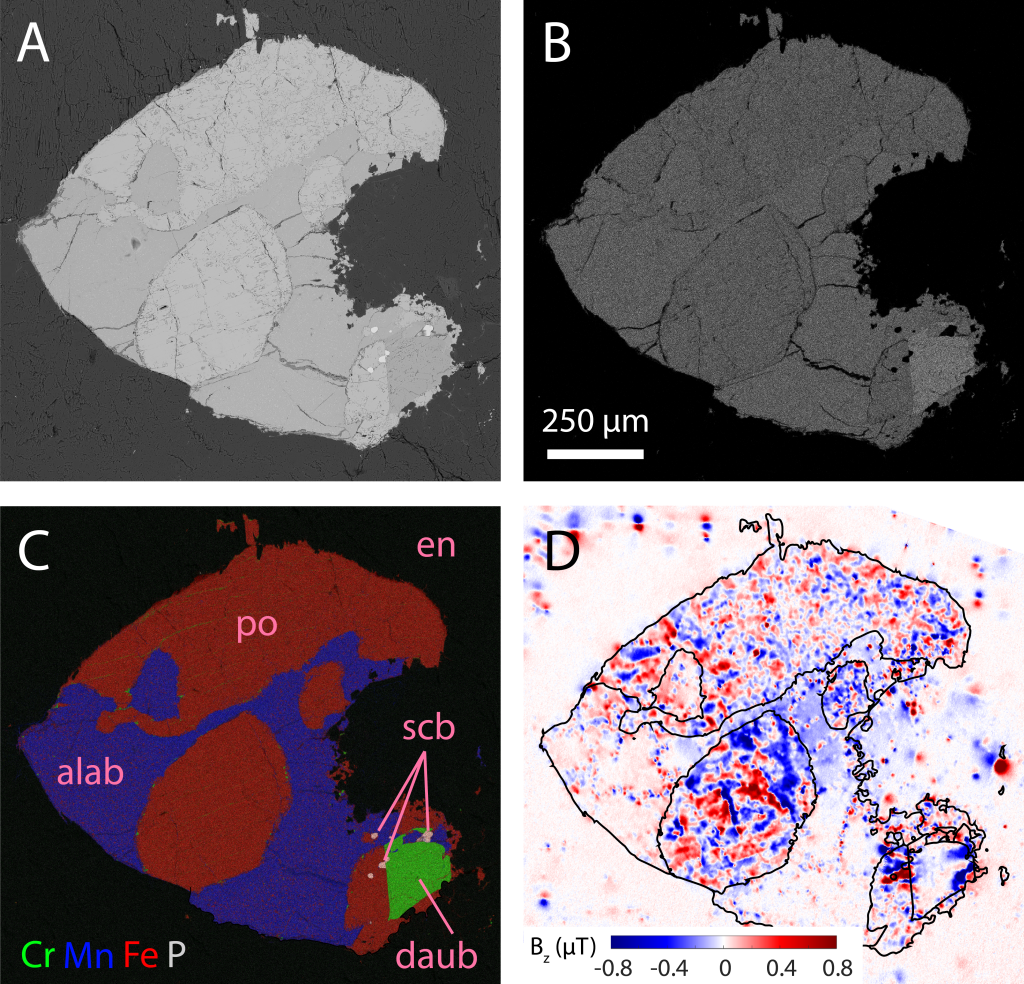
What minerals carry magnetization in the crust of Mercury? Because Mercury is a much more reducing environment than Earth, a wide variety of minerals have been proposed as potential remanence carriers including exotic sulfides, phosphides, and silicides. The rarity of these minerals means little is known about their basic magnetic properties. Hence, while aubrites and eucrites offer an opportunity to study reduced mineral assemblages in real samples, it is challenging to interpret bulk magnetic measurements.
By combining high-resolution magnetic imagery from the QDM with compositional and crystallographic data, I am working to identify remanence-carrying minerals in aubrites and eucrites in situ. My preliminary work has revealed remanence associated with phases typically thought to be antiferromagnetic or paramagnetic at room temperature.
Read the LPSC abstract here!
High-pressure magnetic imaging
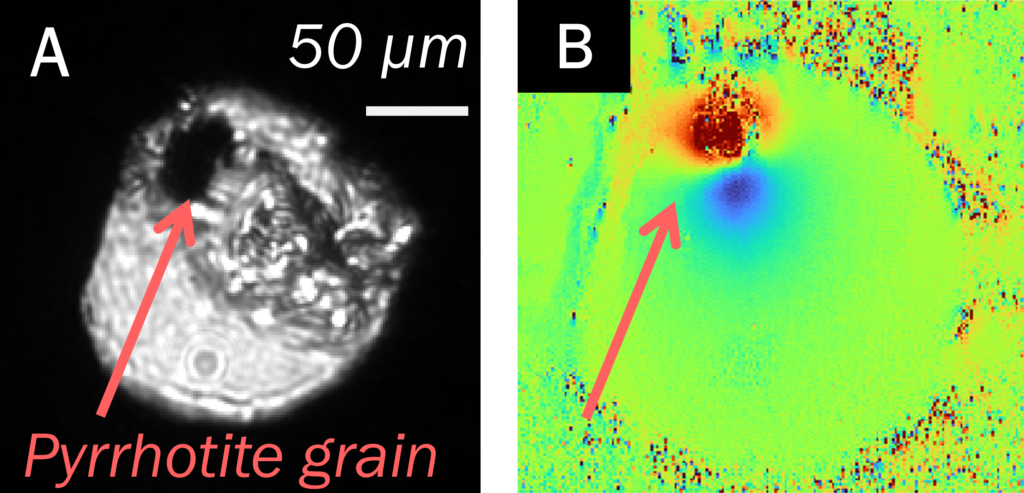
A pyrrhotite grain from EET A79001 loaded in a QDM-DAC, including a transmitted light image of the source (A) and the corresponding magnetic field map (B).
A key question for meteorite paleomagnetism–especially for Martian meteorites–is the extent to which shock can permanently reset remanence.
We are currently working on using the recently developed hybrid quantum diamond microscope-diamond anvil cell (QDM-DAC) to magnetically image Martian materials under high pressures.
Read the LPSC abstract here.
Quantum diamond microscopy
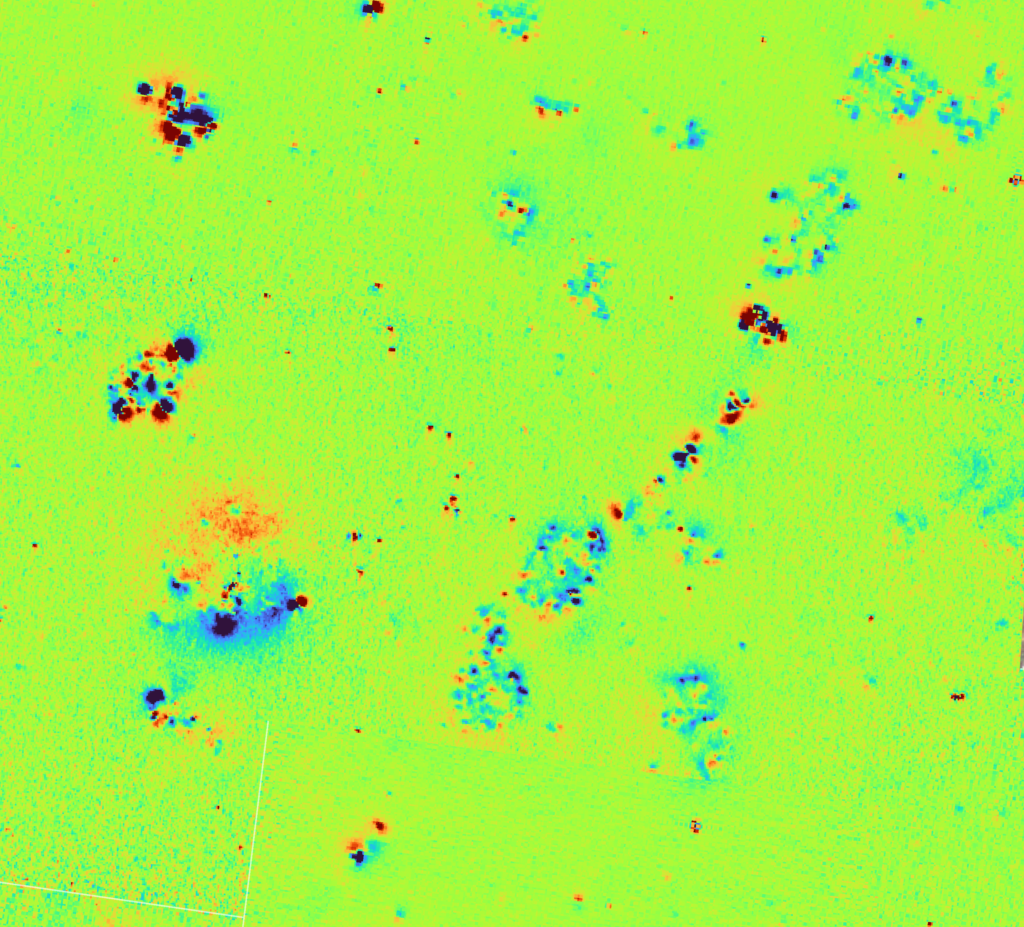
A magnetic map of a slice of ALH 84001 produced with the quantum diamond microscope at the Harvard Paleomagnetics Lab.
My paleomagnetic work is almost entirely performed using the quantum diamond microscope (QDM) and QDM-DAC in the Harvard Paleomagnetics Lab, which use NV fluorescence in diamond to magnetically image samples at micron-scale resolution. I’m interested in developing procedures for analyzing complex magnetic data, with a particular interest in inversion techniques.